
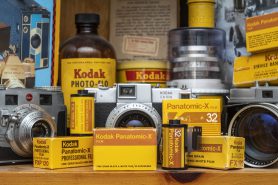
Kodak Panatomic-X, first released in 1933 as a sheet film, is the author's favorite film of any kind from any manufacturer. Over the decades it went through several speed revisions (25, 32, and at one point ASA 40) and periods of discontinuation and reintroduction, eventually returning in 35mm and roll formats in the 1950s and remaining in production for decades as the go-to choice for photographers needing maximum detail in black and white. While most sources cite 1987 as its discontinuation date, the author owns rolls expiring in 3/1990, casting some doubt on that timeline.
The author's hands-on experience centers on Pan-X's remarkable resistance to aging—rolls from the 1960s, 70s, and 80s have consistently shot close to box speed with minimal degradation, though 35mm survives better than 120 due to backing paper issues like ink transfer and mold. Other photographers have reported the same phenomenon. For development, the author favors HC-110 dilution B at 6.5 minutes, slightly longer than Kodak's recommended 4.5–5 minutes at 68 degrees, speculating the extra time may compensate for the film's age; stand and cold stand development didn't improve results. Sample images were shot with cameras including a Leica Model A, Voigtländer Ultramatic CS, Mamiya Auto XTL, and Nikkorex F, all at box speed. Two vintage Kodak articles from March and June 1956 announcing Pan-X's reintroduction in 35mm and roll formats reveal that the emulsion was completely reformulated at that time, alongside a similarly revamped Plus-X. Both praised its extremely fine grain and sharpness, with one article even warning it was too sharp for flattering portraits. Notably, the articles state Pan-X could be shot at more than double its box speed thanks to exceptional exposure latitude.
The author concludes that this latitude, combined with genuine resistance to aging, likely explains why decades-old rolls of Pan-X still produce excellent results—an old expired roll pushed or shot at box speed remains well within its capabilities. The overall takeaway is a strong endorsement: for photographers seeking maximum sharpness and clarity, Kodak Panatomic-X had no equal in the late 1950s, and the author maintains that this holds true even 60-plus years later.
AI-generated summary. May not capture every detail — read the full article below for the complete picture.
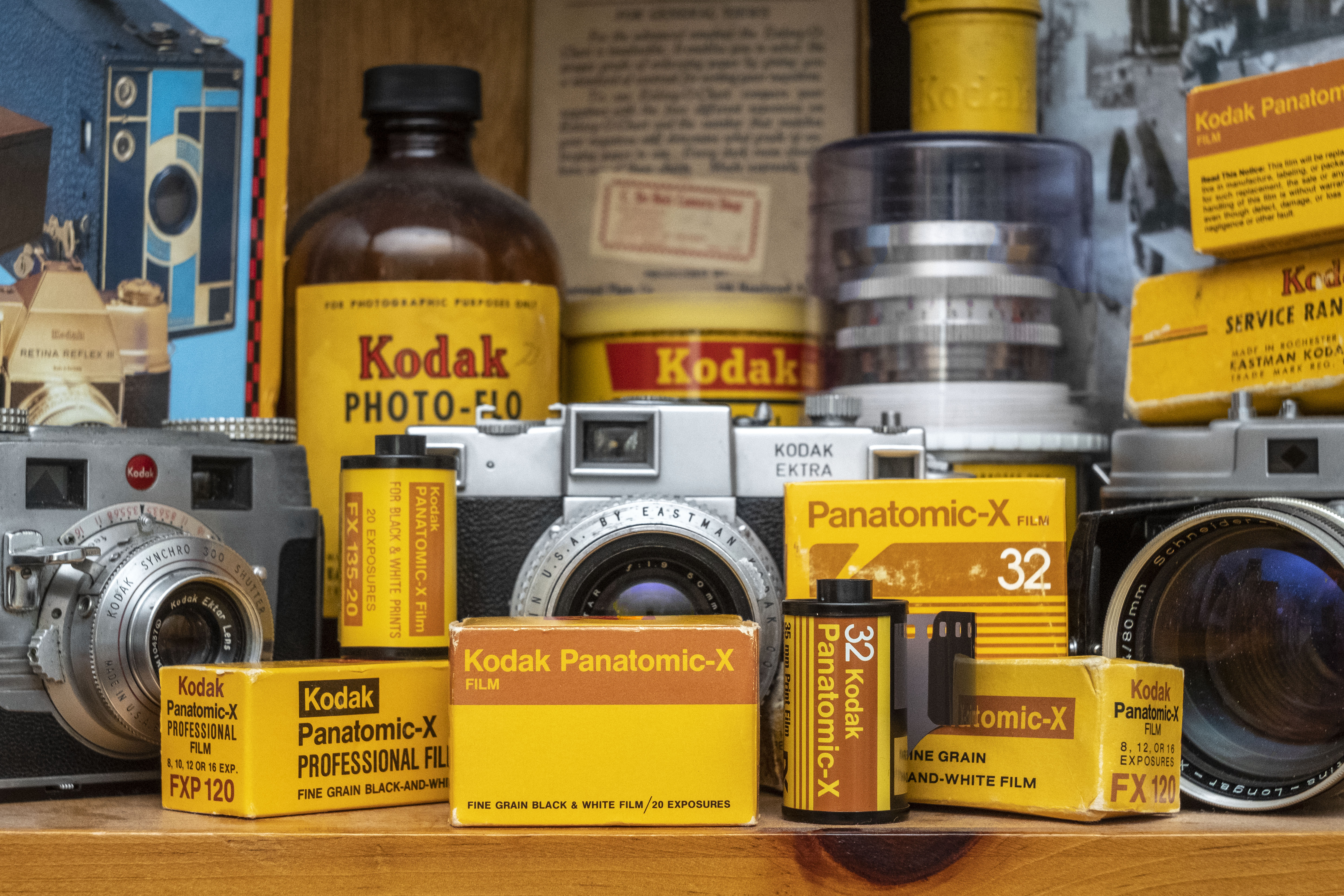 In this Keppler’s Vault series, I’ve shared articles about many of Kodak’s classic black and white films such as Tri-X, Plus-X, and even Royal-X, but the time has come for what is not just my all time favorite Kodak film, but probably my all time favorite film of any kind by any company, Kodak Panatomic-X.
Originally released in 1933 as a sheet film, Kodak Pan-X has gone through several revisions, changing speeds from 25 to 32, and at one point, ASA 40. The film has always been a slow, fine-grain emulsion, ideal for large prints that retain a ton of detail.
As faster films came and went, at one point Kodak would discontinue Pan-X only to bring it back in both 35mm and medium format roll films in the 1950s. It would stay in continuous production for the next several decades as the professional’s choice when absolute detail must be maintained in black and white images.
Every single site online suggests that Pan-X was discontinued by Kodak in 1987, but I have a couple of rolls in my inventory with an expiration date of 3/1990, so unless those were from the very last batch, produced three years earlier, I am not sure the 1987 date is correct.
Regardless of when Pan-X was actually discontinued is largely irrelevant because the most amazing attribute of this film is how it continually defies aging. I’ve shot rolls of Pan-X discontinued in the 1980s, 70s, and 60s, and the film almost always shoots at box speed, with little in the way of degradation. My experience is that the 35mm versions survive longer than the 120 versions, not due to any differences in the film itself, rather 120 film backing paper interacts with the film causing ink transfer and in some cases, mold due to moisture wicking through the paper.
My experiences with the seemingly immortal life of Pan-X are not unique to me, as I’ve spoken to many other photographers who have witnessed the same things themselves. If you find a roll of 35mm Pan-X from 1977 in a closet somewhere, just shoot it at ASA 25 and you’ll likely get a whole roll of great shots.
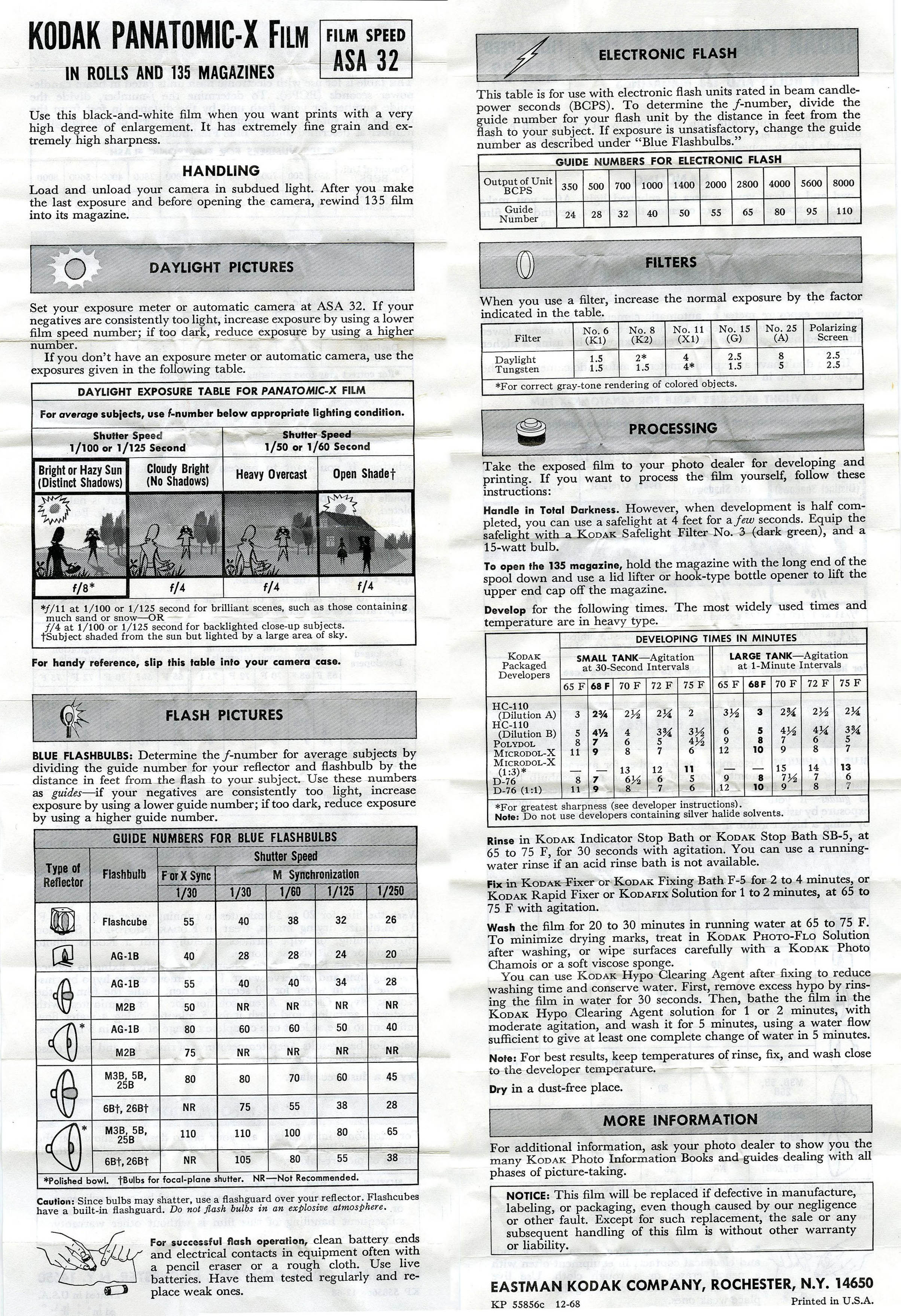
The film also seems to work really well using HC-110 dilution B for 6.5 minutes. I’ve tried developing this film using stand and cold stand development and the results did not improve any. The data sheet to the left lists recommended development times for HC-110 B between 4.5 and 5 minutes at 68 degrees, so perhaps the extra time I’m giving it is counteracting the age of the film somewhat. The chart also has recommended timings for D-76, Microdol-X, and Polydol.
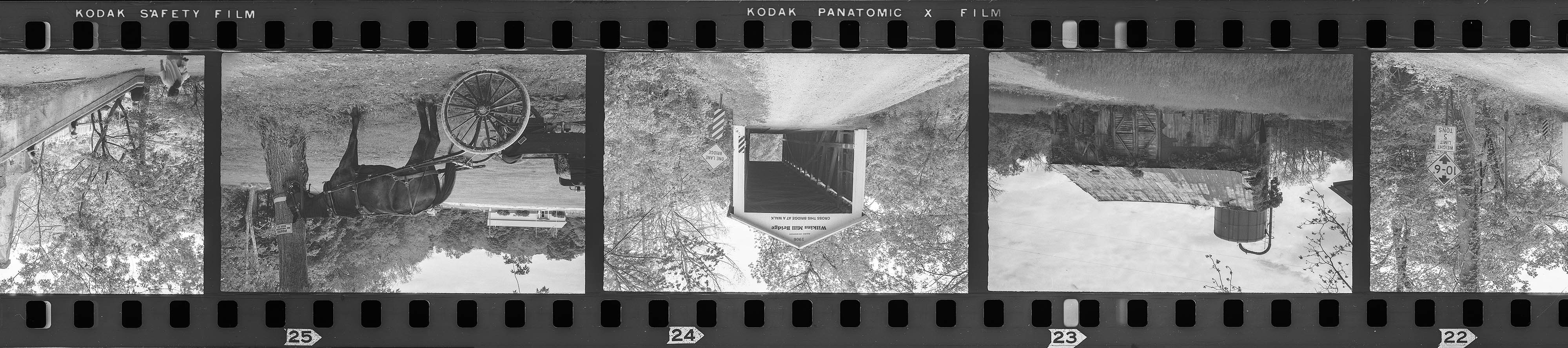
The following gallery consists of images I’ve shot using some form of Panatomic-X whether it was the ASA 25 or 32 versions, and at least a couple of then came from an undated bulk roll I had. The cameras used to shoot these were the Leica Model A, Voigtländer Ultramatic CS, Mamiya Auto XTL, and a Nikkorex F. In every case, the films were shot at box speed, and developed at home using HC-110b for 6.5 minutes.


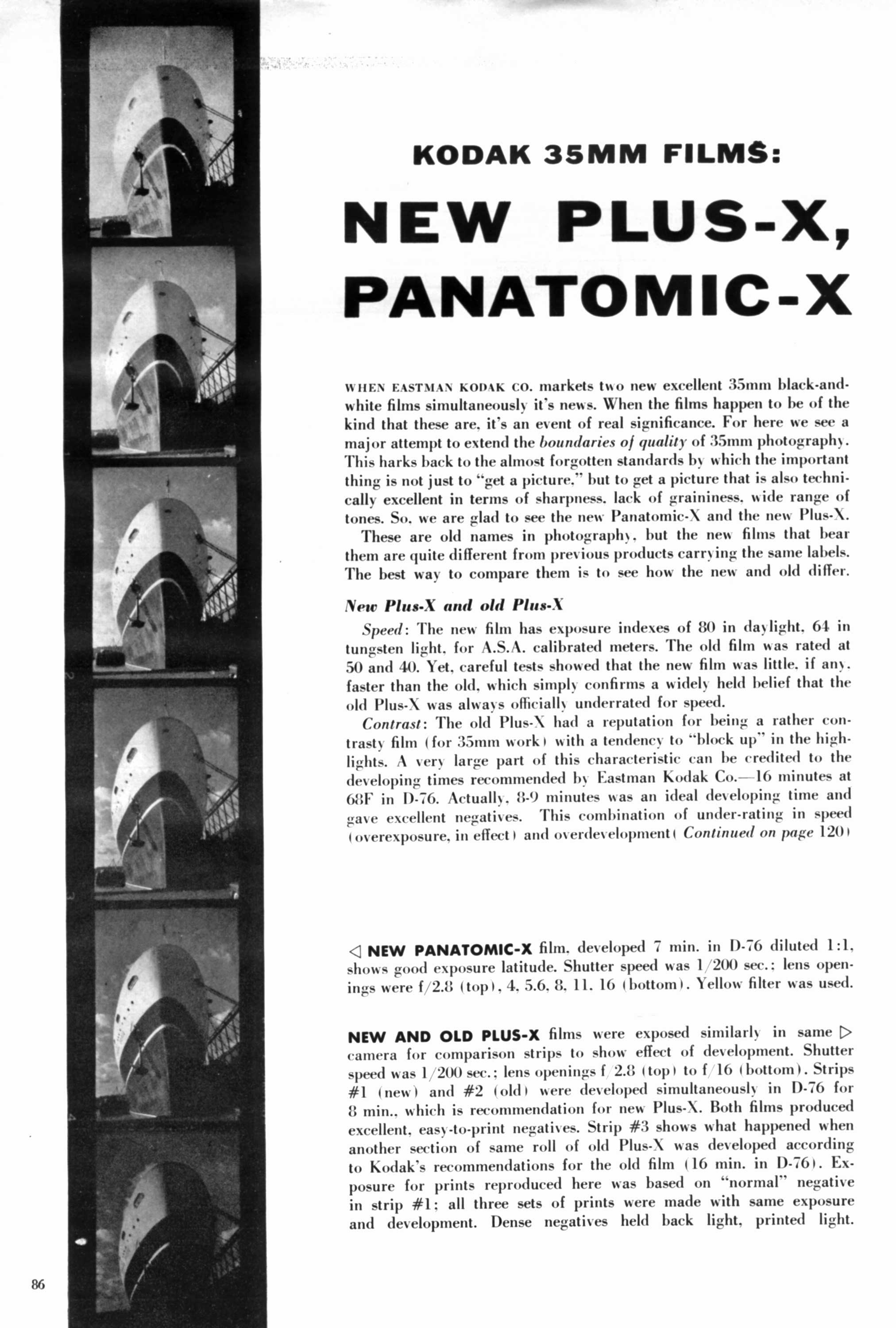
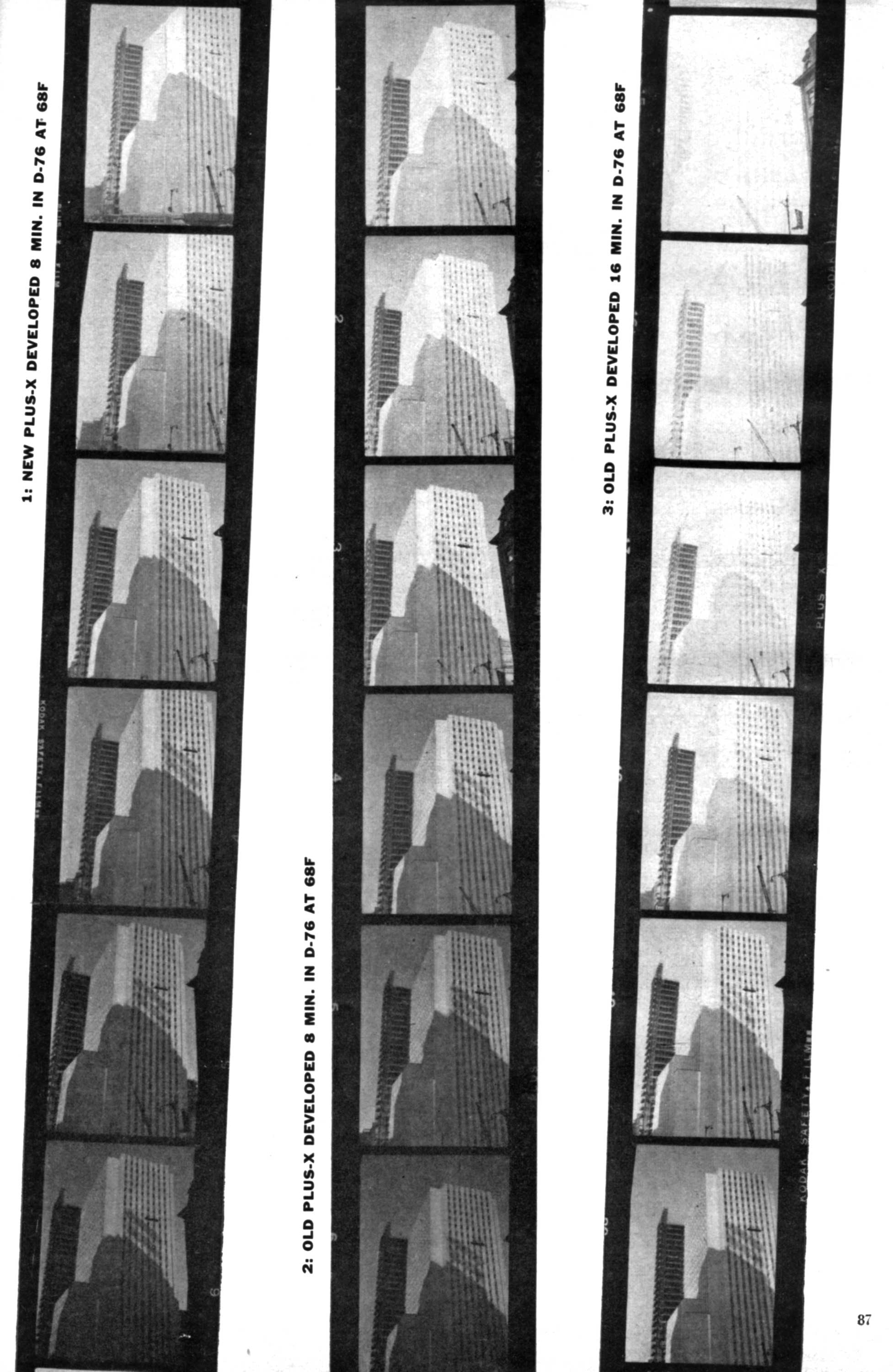
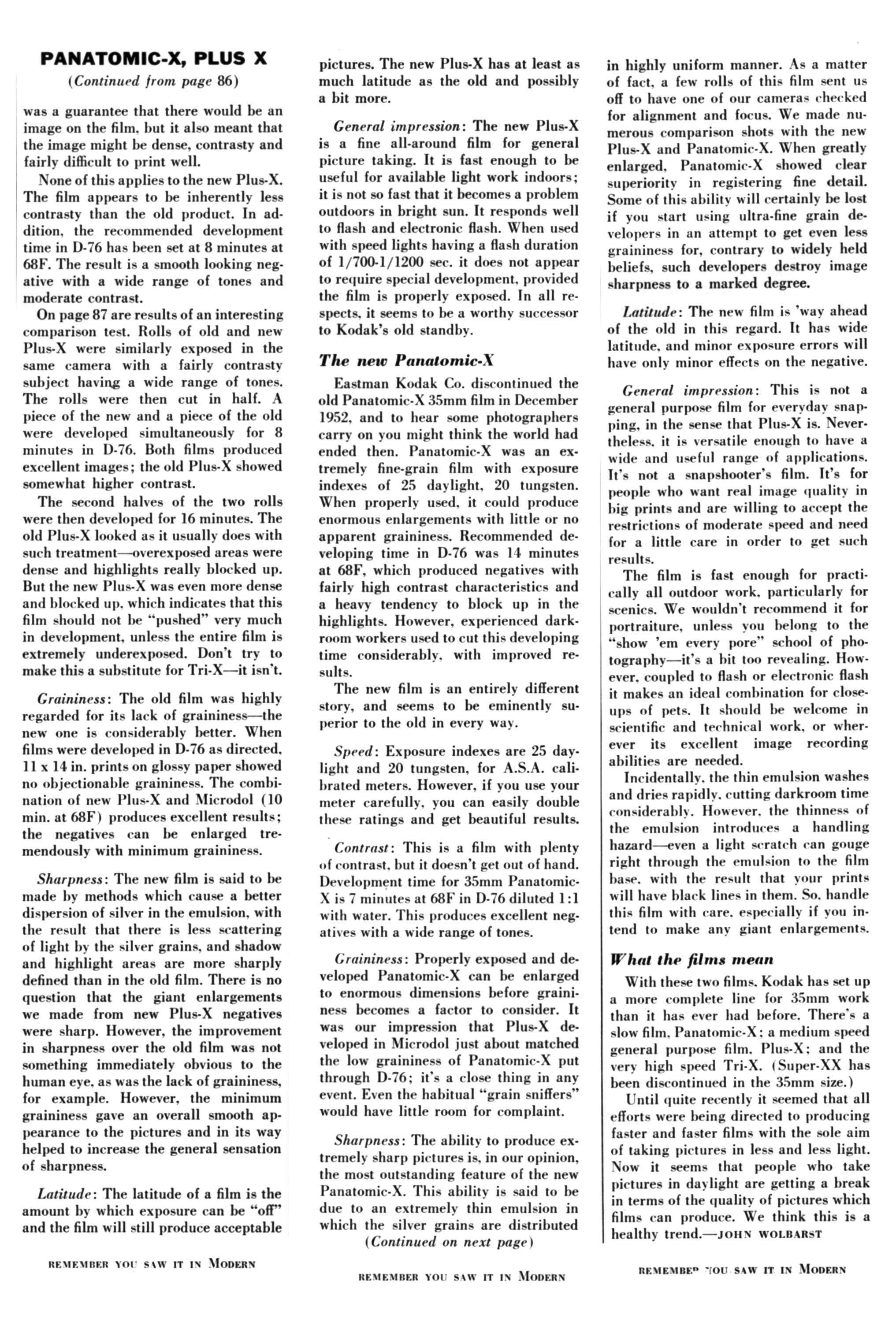
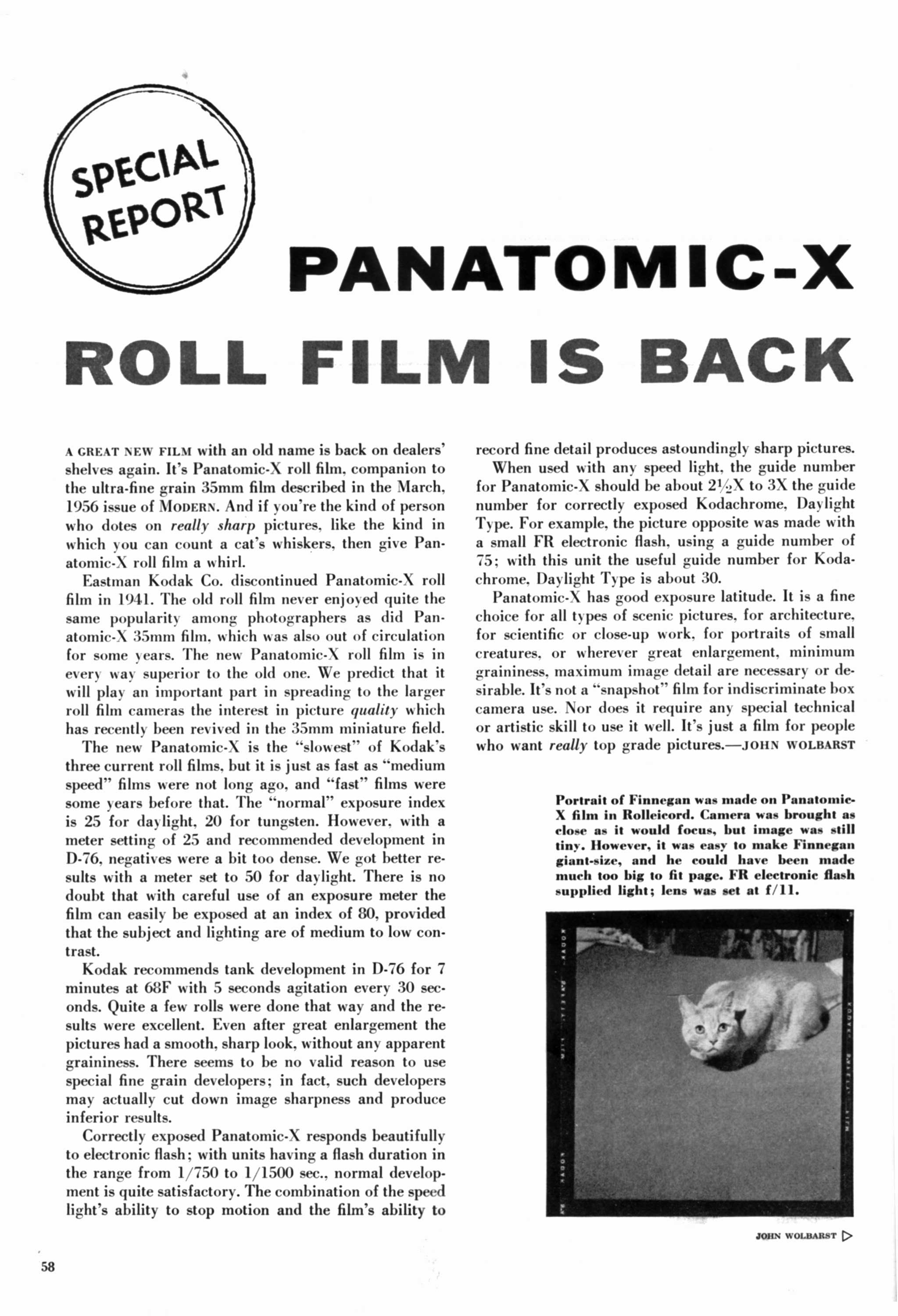
This week’s Keppler’s Vault brings two short articles, the first from March 1956, re-introducing Pan-X in 35mm format after a short hiatus, and the second from June 1956 which also announces it in roll film formats for the first time since 1941.
Throughout the life of most film stocks, it seems that formula changes happen from time to time and that’s what happened with this re-release of Pan-X in 1956. Both articles state that the new Pan-X (and the new Plus-X which was also re-released at the same time) were completely different from the previous versions. Both mention the same things I love about the film such as it’s extremely fine grain and high level of sharpness. At one point in the first article, the author suggests that Pan-X wouldn’t make for a good portrait film as the film is too sharp that it would reveal unwanted imperfections!
One thing I found really interesting, which might help explain part of the longevity of Pan-X is that both articles suggest the film can be shot at speeds more than two times faster than it’s box rating. The film has incredible latitude, which when dealing with older films, the usual statement of +1 exposure for every decade of exposure would mean that an ASA 80 film pushed two stops would be ASA 20, which when you shoot it at it’s box speed of ASA 25 is still well within the film’s limits. So perhaps Pan-X isn’t as impervious to time as I’ve given it credit for, rather, a combination of extreme latitude, plus a very good resistance to age is why so many old rolls of Pan-X can still be shot with excellent shots today.
Whatever the case, it seems that if you were a photographer in the late 1950s and extreme sharpness and clarity was your goal, there was none better than Kodak Panatomic-X, a statement that I agree still applies today, 60+ years later!

All scans used with permission by Marc Bergman, 2020.
Spot on. Pan-X is a great film that stands the test of time. I usually shoot it at ISO 25. Love being able to shoot wide open under normal conditions, too.
Panatomic-X along with Plus-X were my main films from the 1950’s thru the late 1980’s. I can still remember my fury when Kodak discontinued it in 1987. I bought and stored 25 rolls which lasted me for 15 years. I usually shot it at either 32 or 50. I do remember that it was the only film that I did not follow the manufacturer’s recommendation for development time; I used less time but I cannot remember the exactly what that time was. I do know that when I ran out of Panatomic-X I switched to Ilford Pan F which. while not as good did and does give great results. When Plus-X was ended, my conversion to Ilford was complete.
The film that most closely matched the look and longevity of Pan-X was AGFA APX25, but sadly, that’s discontinued too, and is even harder to find these days. On occasion, rolls of Pan-X can be found cheaply, but not APX25. I see people asking $20-$30 a roll for them.
Interesting article, Mike! Coincidentally, I just received a Kodak Retina 1 Nr141 – opening up the back, there is a label recommending Panatomic 135 film!
That does it!! I’m going to run one of my precious roll through my Hasselblad with the 60 mm f/3.5 @ iso 25.
Thank you for an inspiring write up!
Glad I can inspire you! The only potential flaw in your logic is that if you fall in love with the images, finding more of the film can be difficult!
Thanks once again Mike! I have 12 rolls of Pan-X frozen since new, but as you state above Agfa APX 25 also has an incredibly long lifespan. I currently have 60 rolls, from various sources all frozen since new. I’ve bought all my films from retired photographers, and soon as my Veriwide 100 arrives I will put a few rolls through.
Sadly Kodachrome is gone, but shooting these lovely old fine grained films is the B&W equivalent of Kodachrome, so it’s a privilege to still be able to shoot these incredible films. I would add Efke 25 and Orwo NP-15 in the same realm of super fine grain, high silver content films which I am also collecting.
Back when Panatomic-X was discontinued Kodak called TMAX 100 the replacement, the last production films had a sticker saying this. Kodak Tmax 100 shot at 50-64 and processed in Microdol-X 1:0 was Kodak’s recommended replacement for Panatomic-X.
Cheyenne, you’re going to soon become the world’s depot of expired film! With your supply of APX25 and 127 film, I definitely want to be in your will if any of it outlives you! 🙂
My favorite film too! One of the few films I actually liked Rodinal with, but I mostly used HC110 and D76,
Many of my favorite pictures ever were shot on it. The very best ones, and the easiest to print, were shot at EI 25 and developed so delicately that you could read a newspaper through the densest parts; the negs looked horribly underexposed but laid down perfectly on Number 3 paper.
I completely disagree with the guy who said it was too sharp for portraits; I have many that blew up to 11×14 and still look terrific.
I have about 10 frozen rolls left. Guess I’d better use them before I can’t lift a camera any more.
Fuji Acros is the closest still-living film I’ve found, but it’s really not the same.
I think the comment about the film being too sharp for portraits isn’t due to any lack of the film being able to be enlargened, rather that because it’s so sharp, it reveals imperfections in people’s faces like pimples, wrinkles, and other blemishes, that might otherwise stay hidden with “lesser” films. When people get their photo taken, they often don’t want to see all those imperfections, and Pan-X was so sharp, they became visible.
It was a favorite film of mine as well. That point you made about use for portraits was correct for me. My older brother asked me to take some pictures of he and his fiance for their engagement notice in the newspaper. Since I wanted the pictures to be “high quality” I naturally decided to use Panatomic-X, used direct flash with a reflector (my dad’s Da-Lite home movie screen). This was all I could afford as a 14 year old photographer with a Pentax Spotmatic and 55mm F1.8 Super Takumar (my brother bought me the camera on his way home from serving in Viet Nam.) Then I developed in Microdol-X for maximum sharpness. Well, the pictures were contrasty and extremely sharp. Every pore and blemish was visible on the young couple – not the most flattering treatment. At least when it was printed in the newspaper, it was small and not that sharp.
I guess you could minimize the blemish revealing nature of Pan-X by using a soft focus filter, but if you’re going to do that, it’s a waste of such nice film! If there was one film I wanted Kodak Alaris to bring back, this is it! Maybe somehow, someone from that company will see my article and become inspired to recreate it!
Very interesting summary of the best B&W film ever (in my non-humble opinion). I am still using 120-size Panatomic with expiration of 1989. The film has been in my freezer since new, and so far, it looks fine with no fog or other issues. I expose it at EI=20 or 25. This may be of interest to some of your readers:
https://worldofdecay.blogspot.com/2017/05/panatomic-x-best-black-and-white-film.html
Super helpful, thanks for your post! I have a roll I found “in a drawer” and though I THINK I know what is on it, I can’t wait to develop it. I have a dry pack of D76 and even dry pack of Microdol I may try. Curiously, Panatomic X was NOT in my Kodak “Darkroom Dataguide” . . . thanks again
Kodak Pan-X is really easy to develop as it usually does not require any special steps typical of other expired films. I use HC-110b and develop as normal for 6.5 minutes with regular black and white fixer and I get great results every single time. I am sure it’s the same with D76 too.
I have come into 3 round tins that say they are pan x film that say they were exposed in 1969. I know nothing about film or photography. Where can I get them developed?
I have 2 bulk rolls (150ft) and several loose rolls in my freezer, I’ve started shooting it now the sun has come out. I can’t wait to see the results.
May be Adox CMS20II is a cheaper choice?It’s prone to get from any store.And I guess it might base on Agfa Aviphot Pan 20,a high resolution and low sensitive film.But its crazy contrast is not always friendly so special developer like POTA and Adonidol is necessary.Comparing with Panatomic,its disadvantage is that it doesn’t have unbelievable atitude.